JOHN AND REBECCA PETCHELL
John and Rebecca (nee Wallis) migrated to Sydney from Lincoln, England aboard the “Duchess of Argyle” arriving on the 5th of February 1883. John’s occupation is listed as Shoemaker with their religion listed as Wes, presumably Wesley. John has his age as 53 while Rebecca is 52.
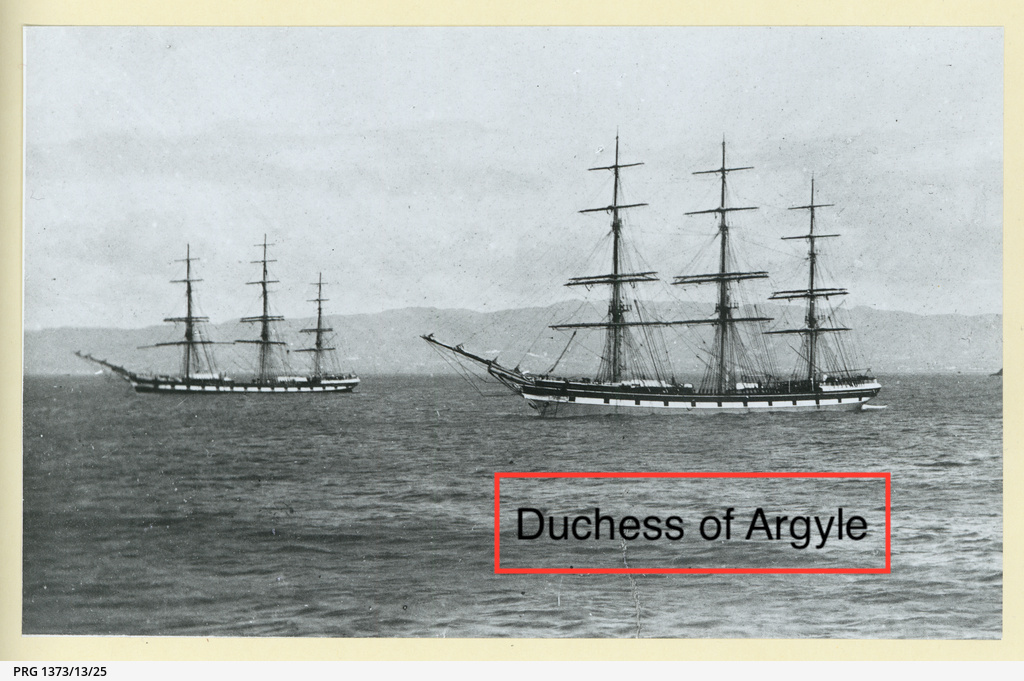
John Petchell was born the 2nd son of William Petchell at Stamford, Lincolnshire, England in 1829.
Rebecca Wallis was the eldest daughter of William Wallis and was born in 1830 at Kettering, Northhamptonshire, England.
John and Rebecca were married on the 31st March 1850 in the Parish Church, Kettering, England.
This union produced 5 children Frederic, Frank, Fannie, Pollie and Mary.
John died at his residence at Brighton-le Sands, Sydney on 20th January 1922 age 92 and is buried at Rookwood Sydney.
Rebecca passed on 19th January 1901 aged 70 at home at Marsden Park, Riverstone. She is also buried at Rookwood.
John remarried later in life and together with his wife Elizabeth, lived at Brighton, Solander Street, Brighton-le-Sands.
MEMBERS OF OUR FAMILY IN ARMED FORCES WW1
These are the stories of our families that have served with the armed forces some in well know battles others in places rarely heard. The men and women who volunteered or were conscripted in times of war or peace to protect us and to fight the freedom we enjoy in Australia.
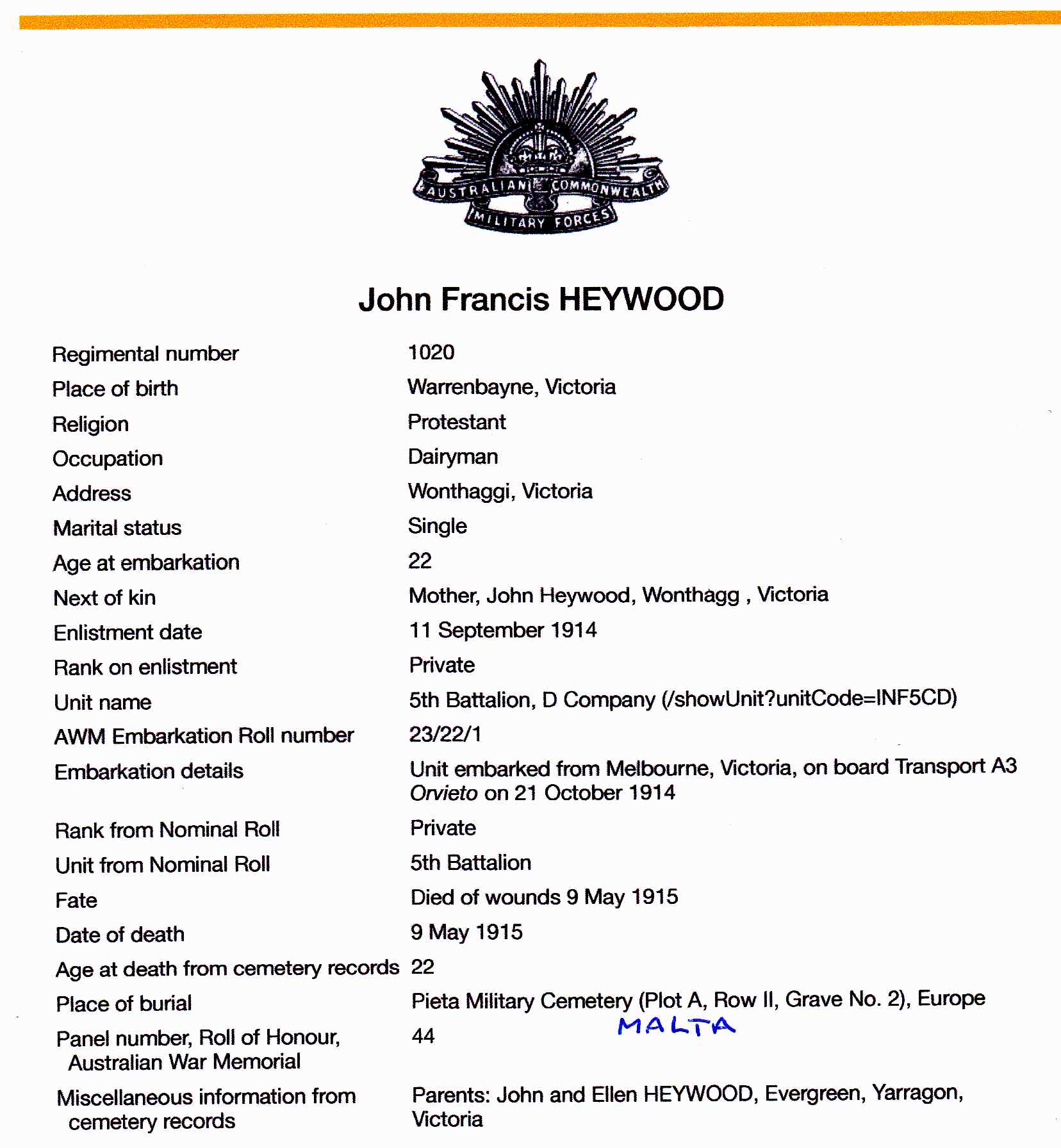
JOHN FRANCIS (FRANK) HEYWOOD (1892)
John Francis Heywood was born on 1892 the third child to Nellie and John Heywood and lived at Warrenbayne Victoria. He was always called Frank.
He was mortally wounded at Gallopoli and died on the 9th May 1915 on Lemnos Island.
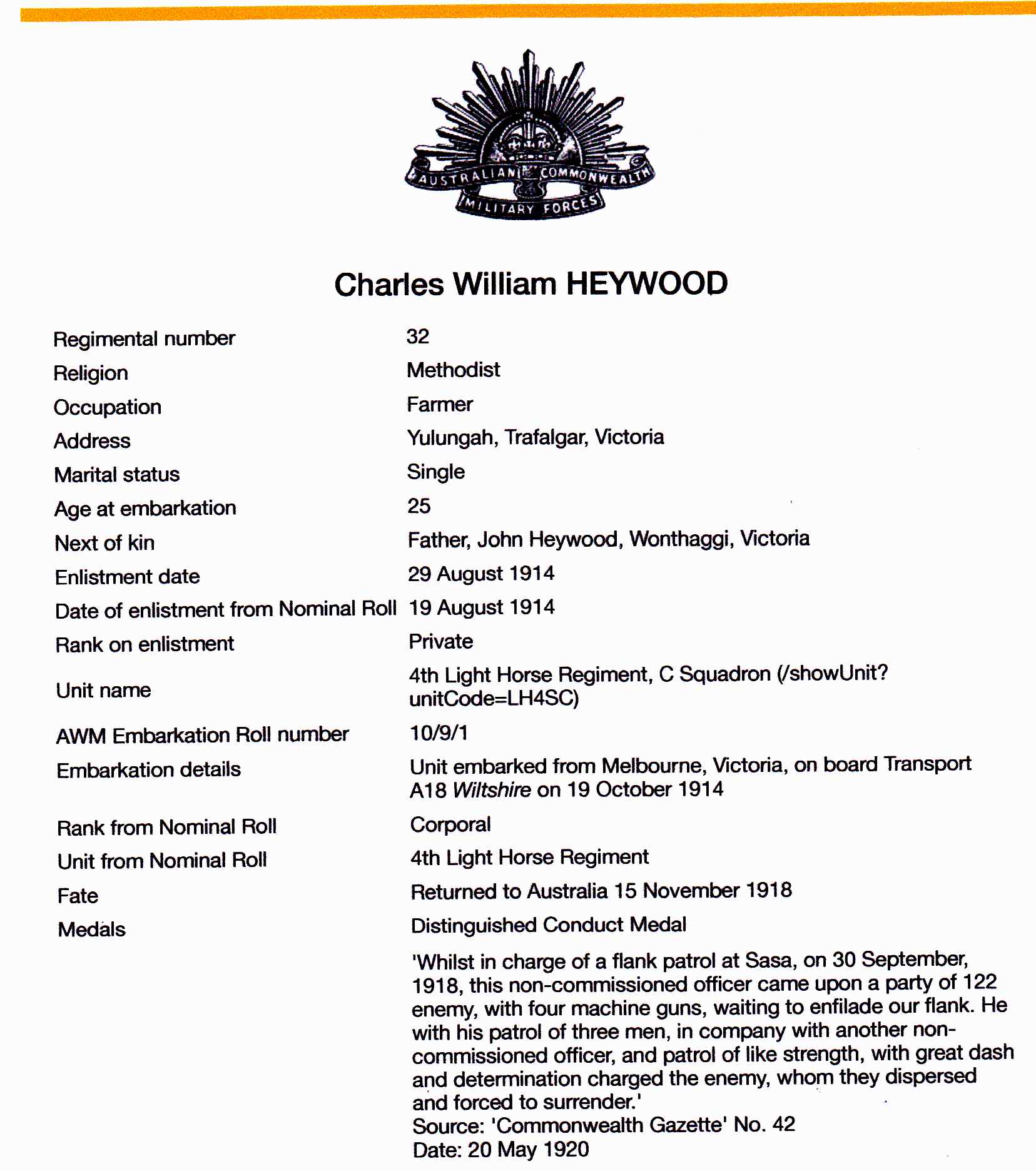
CHARLES WILLIAM HEYWOOD (1889)
Charlie was born on the 22 February 1889 the first child to Nellie and John Heywood. John was a dairy farmer at Wonthaggi - Yarragon.
He died on 30 December 1980.
ALF HEYWOOD (1896)
Alf was born 5 August 1896 at Warrenbayne Victoria, the fifth child of Nellie and John Heywood.
He was the third son of this family to enlist. His parents would not give their permission so he had to wait until his 21st birthday and did so as on the 21 August 1918. Private number V79203 and discharged 24 December 1918.
He did not leave Australia as the First World War was just about finished.
Alf died 28 July 1968.
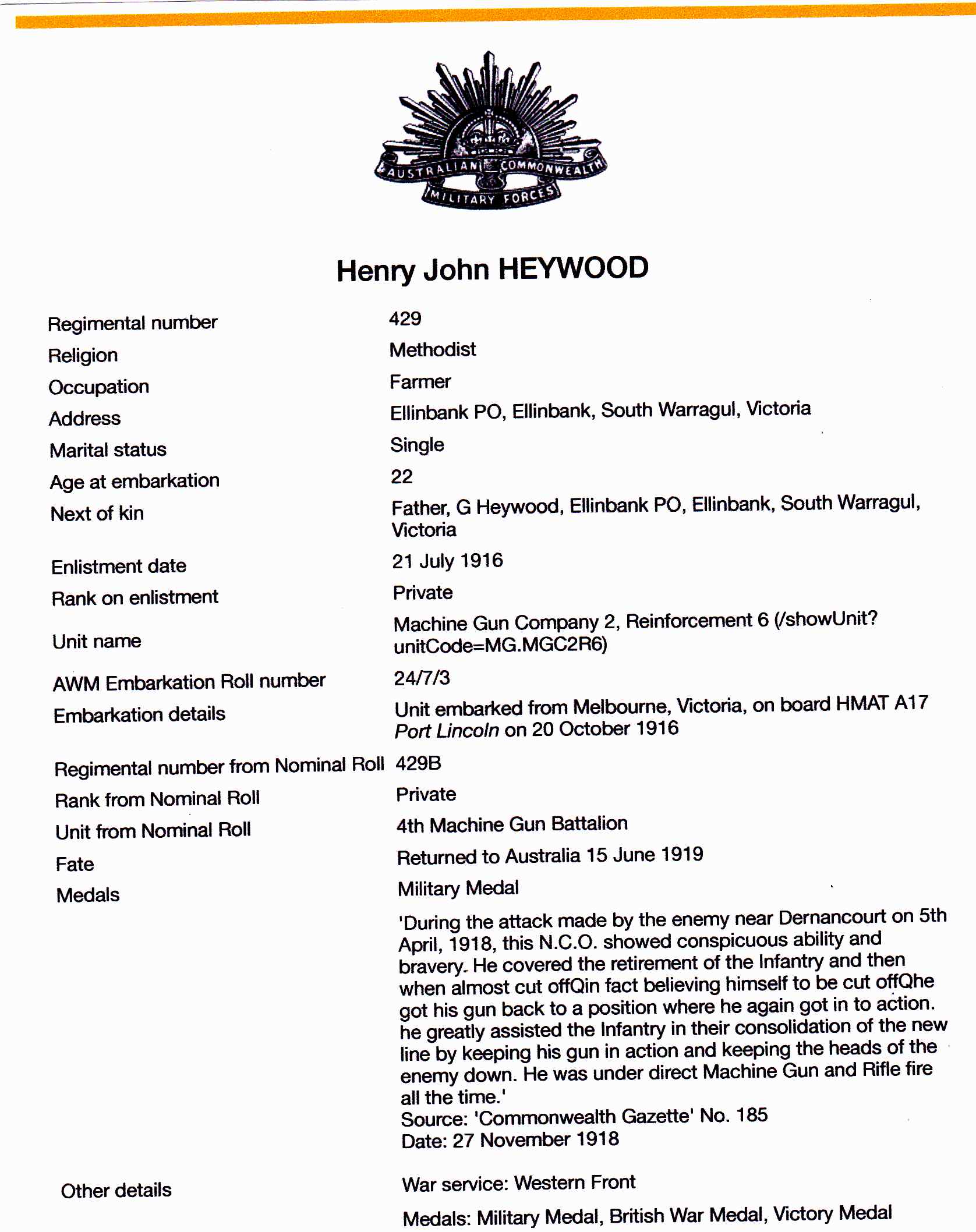
HENRY (HARRY) JOHN HEYWOOD (1893)
Henry John Heywood was born on the 14 September 1893 and lived at Baddaginnie Victoria. He was always called Harry. His parents were Elizabeth and George Heywood.
In 1914 the war situation became more serious. When Harry heard that
Lord Kitchener had been killed he immediately made up his mind to enlist.
He was a sergeant in the 24th Machine gun (Vickers) Company, 4th Division
A.I.F. and served in France and Belgium where he won the Military Medal at
Dernancourt.
Harry claims that the machine gun he was in charge of was responsible for bringing down German’s famous war ace Baron von Richthofen - the “Red Barron"
He was nicknamed. "Nugget” because of his great strength. At General Head Quarters in France, he won the N.C.O’s middleweight championship for the British Empire for wrestling – army navy rules.
He married Bertha Lucinda Cropley 24 January 1923 at Ellibank Victoria. They raised four children Glenda, Marjorie, Wesley and Murray. Harry died on 10 September 1983 and is buried At Warragul Victoria.
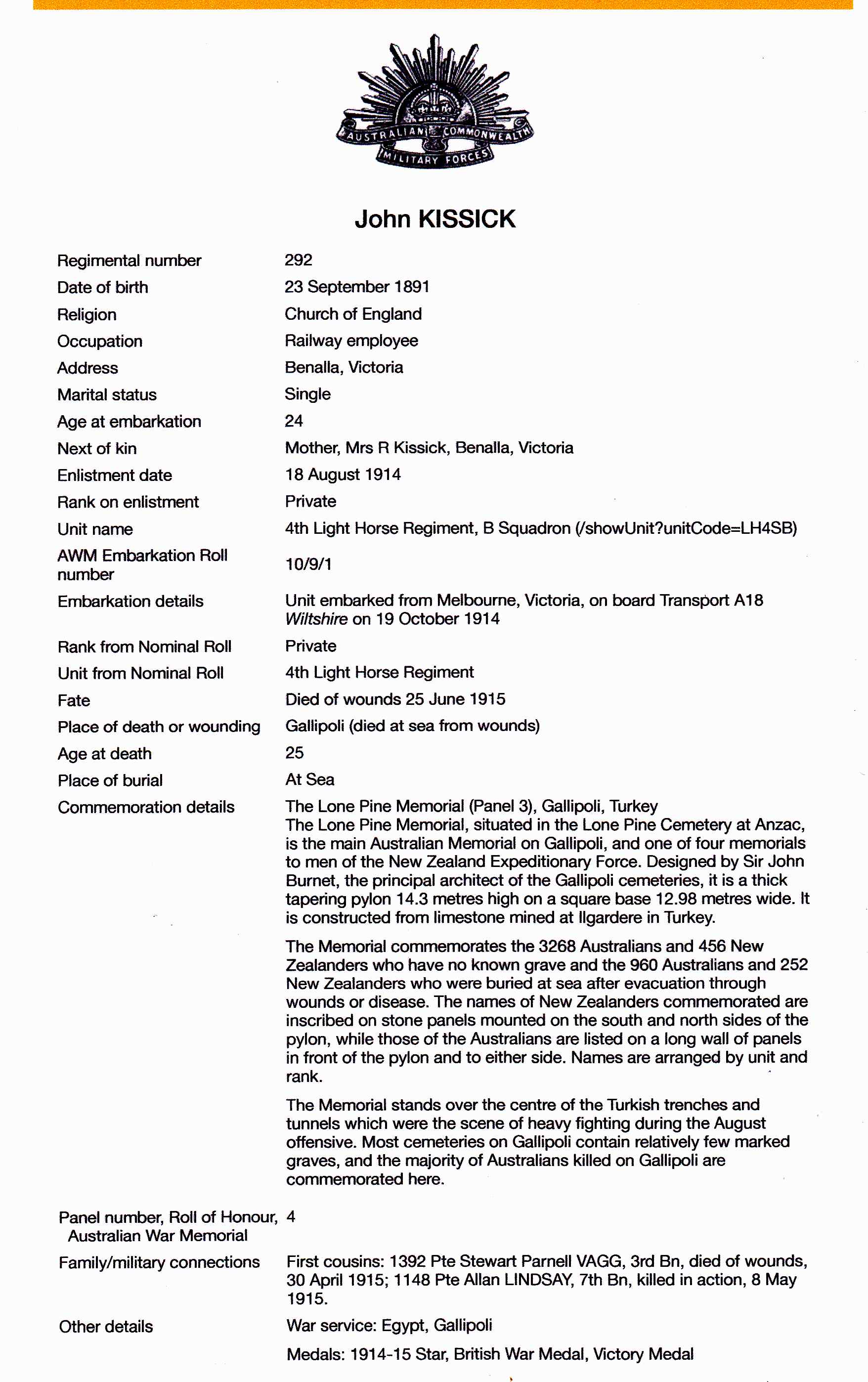
JOHN KISSICK(1891)
John was the son of Catherina and Ewan Kissack, brother of Mabel, Sarah, Martha, Catherine and Annie.
He died after action at Gallopoli.
MARTHA KISSICK(1879)
Martha was the daughter of Catherina and Ewan Kissack, sister of John, Mabel, Sarah, Catherine and Annie.
She served in the Middle East as a nurse.
From website AUSTRALIAN NURSES IN WORLD WAR 1
KISSACK, Martha
Staff Nurse
AANS
Born 1879 at Benalla, Vic
Daughter of Robert KISSACK and Martha nee WALKER
Address Nunn St, Benalla, Vic
Age 32 years
Training 3 years Colac Public Hospital
Enlisted 15 June 1917
Embarked 30 June 1917 in Melbourne per “Somali”
Service in Bombay
Returned to Australia per “Eastern” 13 April 1919
Appointment Terminated 20 August 1919
Did not marry
Died 22 June 1964
Buried Benalla Cemetery
BILLY GRIFFIN
The book "Captain Thunderbolt & his Lady" written by Carol Baxter in chapter 26 starting at page 232 talks about William Ward's time at Carroll. It names GG Grandfather William Griffin as the owner of the Albion Inn at Carroll when Captain Thunderbolt held up everyone in the Inn at 4 o'clock on Sunday 10th December 1865.
He rode from Tamworth to Singleton to give evidence in the trial of Kelly.
Mary Ann Bugg, Fred Wards lady left Fred and had another baby at Carroll in August 1868 Frederick Wordsworth Ward. She now was living with John Burrows. She died in Mudgee 22 April 1905. Page 336, Mary Ann worked at Griffin's Inn at Carroll. The Innkeepers wife and wife of another robbery victim helped deliver her child Frederick Wordsworth.
TROVE. Billy Griffin died 23 October 1931 aged 92 years buried at Goolagimba Qld. He was born at Singleton shortly after his parents Edward and Mary has migrated from Kent England on 22 March 1842. Educated at Singleton teacher Dr White. Served in British East Africa in charge of a bridge building and painting gang on Mombasa to Port Florence railway line.
Normal 0 false false false EN-AU X-NONE X-NONE /* Style Definitions */ table.MsoNormalTable {mso-style-name:"Table Normal"; mso-tstyle-rowband-size:0; mso-tstyle-colband-size:0; mso-style-noshow:yes; mso-style-priority:99; mso-style-parent:""; mso-padding-alt:0cm 5.4pt 0cm 5.4pt; mso-para-margin-top:0cm; mso-para-margin-right:0cm; mso-para-margin-bottom:10.0pt; mso-para-margin-left:0cm; line-height:115%; mso-pagination:widow-orphan; font-size:11.0pt; font-family:"Calibri","sans-serif"; mso-ascii-font-family:Calibri; mso-ascii-theme-font:minor-latin; mso-hansi-font-family:Calibri; mso-hansi-theme-font:minor-latin; mso-bidi-font-family:"Times New Roman"; mso-bidi-theme-font:minor-bidi; mso-fareast-language:EN-US;}
Ellen Maude Heywood
(19 Sept 1909 - 7 Sept 2010)
MAUDIE’S HONOR OF A LIFETIME.
RETIREMENT
Maudie Heywood has become an honorary member of the Oblate Fathers, the only one in Australia.
Maudie, who at the age of 28, became house-keeper at the Sorrento presbytery for 58 years, was honored in recognition of her service to the Catholic religious order.
Maudie said she hasn’t noticed time pass at the presbytery. “Fifty eight years ago I was looking after my family as my mother had died. One by one they left home to get married or go into the Army.
Father McCusker asked me to be house keeper at the presbytery for a two month trial.
“I kept waiting for him to ask for a decision. He never came back.”
Maudie said she had never regretted her time with the Oblate's
“This recognition was a total unexpected and appreciated. It’s a great honor.
Present parish Priest Father David Shelton paid tribute to Maudie’s many years of service.
“Everyone appreciates her efforts. She looks after all of us very well, and keeps everything running smoothly”, he said.
Maudie died aged 12 days short of her 101st birthday.
Extract from Local Newspaper.
JOSEPH HEYWOOD OF BOLTON LE MOORS 1802
Joseph Heywood was bon on the 11th July 1802 at Dukes Alley, Bolton le Moors, England. He married Mary Thompson on the 26th April 1824 at Manchester Cathedral. They first lived at Farnworth by Bolton at Halshaw Moor where they produced their first 8 children, Elizabeth, Eliza, Jane, Susan, Alice, Joseph, William and Mary. The family then moved to Kiln, Little Lever where the next 6 were born. This is confirmed in the 1841 Census. Joseph was a butcher having his shop in Little Lever with his residence upstairs. His brother Peter Heywood (1807) was a joiner and builder. The two brothers together with 4 of Joseph's children Susan (1829), Joseph (1833), John (1839) and Robert (1842) set sail from Liverpool on 27th October 1852 aboard the South Sea. The South Sea was a 950 ton vessel which bought our Heywood's to Australia in 1853. In the book "Our Master Marines" edited and published by Mrs HA (Jennie) Woods there is a passage which talks about Captain William Brett. It states. .. "Later he was in command of the 'South Sea', a vessel of 950 tons, conveying 482 passengers, including 6 children - 4 adults died on the voyage. The voyage was from the 27th October 1852 to the 15th February, 1853 being 110 days. The four deaths were reported in the Melbourne 'Argus News' of the 16th February, 1853." The documents on which this book is based have been donated to the Mitchell Library and may have further detail on this voyage. A check of The Argus:Melbourne newspaper for Wednesday, February, 16, 1853 in the Shipping lntelligence, Arrival column states "February 15. - South Sea, ship 950 tons, W. S Brett, from Liverpool Oct. 27. Passengers cabin: Mrs Staunforth and family, Dr. Ewer and family, Mr. and Mrs. Gould, Mr. and Mrs. Black, Mrs. McEwen, Miss Flavell, Mrs. Brown, Mrs. Brett, Mr. and Mrs. Drew and family, Messrs. Faithful, Hood, Couchman, Gills, Barney, Johnson, Saunders, Harrison, Montgregion, Holt, Whittaker, Tart, Pattison, Hopkirke, and 450 in the steerage. Willis and Morry, agents. "From the Public Record Office Victoria (online at www.prov.vic.qov.au) a search of the Unassisted Shipping lndex of lnward Passenger Lists '1852-1889 (fiche 30, page 7) shows our Heywood's (spelt incorrectly as HAYWOOD) arriving on the South Sea in February 1853. This index shows the number of passengers as 381. The Heywood's listed are Joseph age 50, Peter age 45, Susan age 22 (should be 23), Joseph age 10 (should be 19), John age 19 (should be 13), Robert age 12 (should be 11). Joseph Heywood (1802) and Peter Heywood (1807) both died after contacting a malignant fever when calling at St Jago lsland off the African coast. Joseph died on the 27th December 1852 while Peter died 21 January 1853. The 4 children as reported in an article in the "Bolton Journal & Guardian" in 1853 were left in the care of Thos Taylor whose passage was paid for by the Heywood's. Information in a letter seen by the paper states the children are in Melbourne and are likely to be engaged at a salary of eleven pounds per month for the four. Research has found that there was a Thomas Taylor onboard the South Sea whose age was 20 years on departure. lt is questioned why the Heywood children two of which were of similar or older age would be left in his care. There were six other Taylors onboard. Also the question of the relationship of Thomas Taylor to the Heywood's and why they would pay his passage has not been solved.
The following is a copy of a letter written by Margaret Whitworth (1844) nee Heywood, to Agnes May Nickson nee Bittner (1892) on the 19 April 1938 and is a first hand account of the departure by our Heywood's from Little lever. Margaret is the sister of Joseph Heywood (1833) who survived the voyage out to Australia. Margaret remained in England with her mother, brothers and sisters and we are now in contact with many of their descendants. This is one of the few letters between the English and Australian Heywood's that has survived.
541 Tonge Moor Rd
Bolton
Lancashire
19 April 1938
My Dear Niece
My nephew George Ashton is writing this for me, as my eyesight is failing, & I cannot see well enough to write myself.
I was quite thrilled to receive a letter from the grand-daughter of my dear brother Joseph, whom I have never seen since that “never to be forgotten” day, 87 years ago, when he, my father, Uncle Peter, sister Susan, brother John, & brother Robert left the old home in Little lever, to go to Australia.
I was only seven years old, but I can remember it as well as if it was yesterday.
I can remember my mother holding one hand, and my father the other. I can remember John and Robert being so anxious to be off. They were only schoolboys and did not realize the full nature of the parting.
They were just the age to look upon it as a glorious adventure.
That night I was sitting up with mother after all the others had gone to bed. I can understand now; she was nervous, excited, & afraid to be alone, so had kept me up for company.
About eleven o’clock a knock came to the back door. Mother sent me to see who it was. I was afraid to open the door, & shouted “Hullo”!
A voice, (my father’s voice) answered “It’s me”. I could hardly open the door quick enough.
It had big heavy bolts.
He came in & kissed us both. He dared not go upstairs to wake the others, for he had only an hour to stay. He had come back when he found that the ship was not sailing till next morning, for he felt that he must see us all once more if only for an hour.
Then he went away all alone and we never saw him again.
I can remember the day, many weeks later, when the black edge letter came. Mother burst into tears when she saw the black edge, and was afraid to open the letter.
She went out with the letter in her hand, & we saw nothing of her for a long time. I looked everywhere & at last found her, looking dazed’ sitting in the skippose with the letter in her hand.
Though I was only a little girl, I seemed to understand what a great blow it was. Mother would not come indoors. She said “Wait a bit I’ll come soon” but she did not come in for over half an hour.
Well Agnes dear I must close this letter. I see from the family tree that your second name is Margaret, like mine. I am afraid we shall never meet, but I send you my love, and best wishes to all your family & to all the Heywood’s in Australia.
Yours affectionate great–aunty
Margaret.
PS Letter arrived air in good time for my birthday
Margaret.
- You are here:
-
Home

- Uncategorised